
Jetson + STM32 pan tracker
The goal: a camera on a motor that finds an AprilTag and keeps it centered (pan only). A Jetson Orin Nano will run the vision in ROS 2, and an STM32H723 will run the motor in a 1 kHz closed loop under FreeRTOS, shutting the motor off if the Jetson stops responding. The two already talk over CAN at 1 Mbps.
- p99 control tick jitter
- 77 ns
- CAN to the Jetson, 0 errors
- 1 Mbps
- camera, 0 dropped frames
- 720p60
- motor stop with braking
- 37 ms
Done
- Jetson on JetPack 7.2.1 and ROS 2 Jazzy, IMX219 camera
- STM32 bring-up at 520 MHz: FreeRTOS tasks, logging, UART CLI
- CI: host tests and firmware build on every push
- 1 kHz control tick, 77 ns p99 jitter
- Board clock moved from the ST-LINK’s RC oscillator to its crystal (0.43% fast to +5 ppm)
- CAN link to the Jetson over a USB-C cable, 10,000/10,000 round trips
- Motor open loop: VNH5019 driver, encoder, current sense, fault latch, braking stop
- 3D-printed enclosures for the motor driver and CAN transceivers
- Nuc-hatch shield rev A designed in KiCad and ordered
Next
- Nuc-hatch bring-up when the boards arrive
- Firmware for the HOME, END+/-, AUX and e-stop inputs, then homing
- Motor update in the 1 kHz control tick, then velocity and position loops
- Safety: heartbeat timeout and watchdog
- ROS 2 tracking pipeline
- Measured latency and step response
Posts
- Nuc-hatch: a shield for my NucleoNov 19, 2026
- My Nucleo's clock was 0.43% fastNov 18, 2026
- Motor bring-up: coast vs. brakeNov 17, 2026
- CAN over a USB-C cableNov 15, 2026
- Control loop jitter on the STM32H723Nov 5, 2026
fretListener
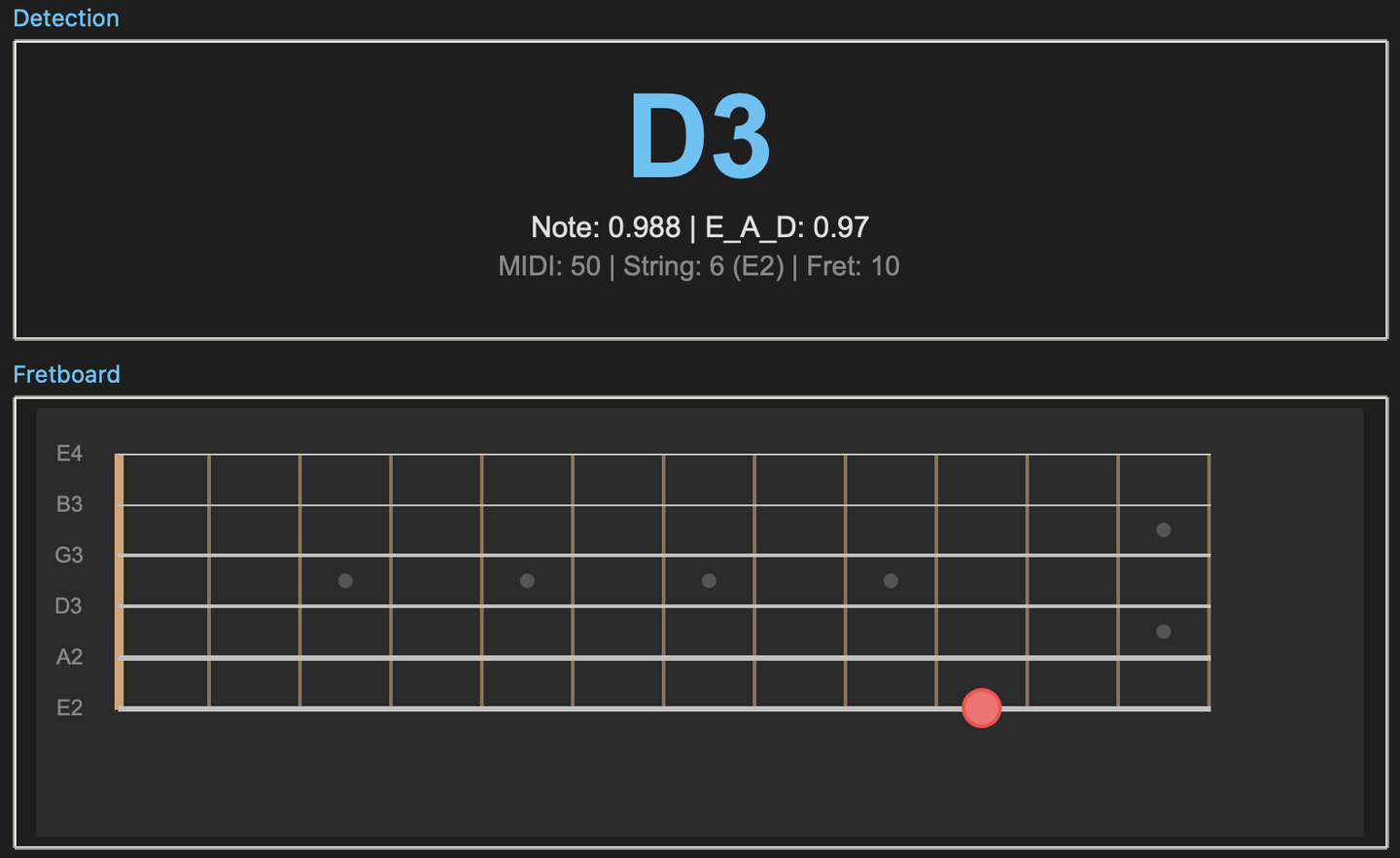
Real-time guitar note and fret recognition from audio. Play a note and it shows the pitch, the string and the fret, live. The same pitch can be played in up to three places on the neck, so a note CNN finds the pitch first, then a small string-disambiguator CNN picks the position by its timbre. Everything is built from scratch: the recording tool, a self-recorded dataset, the training pipeline and two realtime GUI apps.
- hand-recorded clips, about 2 hours
- 12,192
- note accuracy, random split
- 99.8%
- note accuracy, guitar it never heard
- 94.7%
- two-string disambiguation
- 98–100%
Done
- Recording tool: prompts for a position, records takes, slices them at each onset into labeled clips
- Six datasets across Stratocasters and an Ibanez RG550, frets 0–12
- Note CNN for 37 pitches, E2 to E5
- String disambiguators for each neck region
- Live fretboard listener and a scale and arpeggio practice trainer
- Every training run logs its command, settings, curves and per-class accuracy
Next
- A proper held-out test set, plus testing every model on a guitar it’s never heard
- About 10× more clips per region for the 3-string disambiguators
- Chords, bends and distortion (clean single notes only so far)